
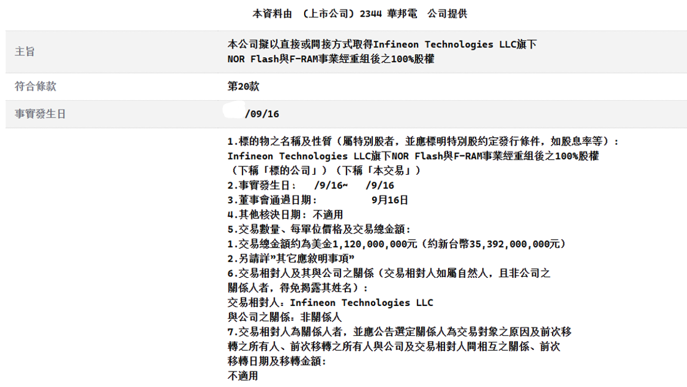
On the evening of September 16, Winbond Electronics Corporation (hereinafter referred to as "Winbond") held a press conference to announce that it has signed a share purchase agreement with Infineon Technologies LLC, a subsidiary of Infineon Technologies AG, to acquire 100% equity of Infineon's NOR Flash and F-RAM businesses in an all-cash transaction. The base transaction price is USD 1.12 billion, subject to adjustments according to relevant provisions of the agreement prior to closing. The transaction has been approved by the board of directors of Winbond Electronics and is expected to be completed in the second half of 2027, pending necessary regulatory approvals.
What truly caught the industry's attention is another detail: upon completion of the transaction, the target company, headquartered in San Jose, California, with over 30 years of deep involvement in memory solutions, will revive a long-dormant name—Spansion.
Peter Schiefer, President of Infineon's Automotive business division, stated that this transaction enables Infineon to further focus on core growth drivers and optimize its product portfolio and capital allocation. Winbond, on the other hand, emphasized that this will expand global R&D resources and strengthen supply capabilities and customer service.
One deal, two strategic narratives. The true motivation behind Winbond's USD 1.12 billion investment lies in the supply and demand landscape of NOR Flash, which is being reshaped by AI.
From Market Dominance to Bankruptcy Restructuring: The 30-Year Rise and Fall of Spansion
The story of Spansion is almost a microcosm of the NOR Flash industry.
In 1993, AMD and Fujitsu established a joint venture, FASL, combining AMD's flash memory technology with Fujitsu's process and capacity advantages.
In 2003, the two parties completely merged their respective flash memory businesses to form FASL LLC, launching the unified brand "Spansion." AMD held a 60% stake and Fujitsu 40%, with headquarters in Sunnyvale, California, and a workforce of approximately 7,000 employees.
Leveraging MirrorBit technology, Spansion quickly rose to become the world's largest NOR Flash supplier. With its fast read speeds and high reliability, NOR Flash was the ideal medium for storing code in feature phones and embedded devices.
In December 2005, Spansion was spun off from AMD and Fujitsu and listed on the NASDAQ, reaching its peak moment.
However, with the rise of smartphones, NAND became the mainstream for data storage due to its lower cost and larger capacity. The NOR market continued to shrink, and the financial crisis further exacerbated the decline in electronics demand.
In March 2009, Spansion filed for bankruptcy protection.
In May 2010, the restructuring was successful. The old shares were canceled, and the company was relisted on the New York Stock Exchange under the ticker "CODE."
In 2013, it acquired Fujitsu's microcontroller and analog businesses, transforming its business model to "memory + MCU (Microcontroller Unit) + analog" as a self-rescue measure.
In December 2014, Cypress Semiconductor Corporation (Cypress) acquired Spansion in an all-stock transaction valued at approximately USD 1.6 billion, which was completed in 2015.
In 2019, Infineon announced the acquisition of Cypress for EUR 9 billion, with the transaction closing in April 2020. The legacy of the former industry leader was thus integrated into Infineon's NOR Flash and F-RAM businesses.
Now, Winbond is taking over and reviving it under the name "Spansion."
The USD 1.12 Billion Calculation: AI Is Redefining NOR Flash
An intriguing detail is that Winbond Electronics is already the world's top NOR Flash vendor by market share. Since it is already number one, why spend USD 1.12 billion? The answer lies precisely in this contrast: it is not buying capacity or market share, but a ticket to the next cycle.
For many years, NOR Flash has long played a supporting role in the memory family, unable to scale up capacity or raise unit prices, and constantly squeezed by NAND. However, the construction of AI infrastructure is pushing this marginal category to the forefront. According to TrendForce estimates, the amount of NOR Flash required for a single AI server is 3 to 5 times that of a traditional server. The densely populated Retimer chips inside servers each require an independent NOR Flash to store microcode; GPUs and communication equipment also need it to host boot and runtime basic programs. In other words, the denser the AI computing power, the higher the usage of these supporting chips, with a particularly strong preference for mid-to-high-end specifications such as high capacity and Octal SPI.
The transmission to the terminal side is equally rapid. As inference capabilities extend to AI smartphones, AI PCs, and robots, the size of built-in models and firmware in devices multiplies, directly driving up the demand for high-density NOR Flash.

Figure: Market Competitive Landscape of SPI NOR Flash in 2024, Source: Winbond Electronics, Guosheng Securities
While the demand curve is rising steeply, the supply side remains almost stagnant. After multiple rounds of reshuffling, the number of remaining players in this sector is very few. In 2024, Winbond, GigaDevice Semiconductor, and Macronix collectively captured 66% of the global market, with extremely restrained additions of new bit shipments. The result is an out-of-control surge in prices.
In this seller's market, time is more precious than money. Rather than building overseas channels from scratch and spending years passing customer certifications, it is better to directly acquire a mature team already embedded in the supply chains of European and American customers. What the target company brings are established customer relationships in the US and Europe, as well as a pool of professional talent across multiple countries, bypassing the pain of integration and avoiding geopolitical sensitivities.
Conclusion
Therefore, what the USD 1.12 billion truly buys is an already established position and a time advantage to complete the layout before the AI demand cycle peaks. The name Spansion is merely a prologue; what Winbond truly wants to revive is the pricing power of NOR Flash in the AI era.