芯耀
芯耀
 与非AI
与非AI





 2298
2298
Recently, the listing of Moore Threads has truly been spectacular, creating wealth for a large number of people. Regardless of how the capital market plays out, a company's ultimate competitiveness still depends on its products. Currently, Moore Threads' products are available on the market, so their performance and features should be clear to those who have used them. Today, EEFOCUS will disassemble an entry-level graphics card, the S10, launched by Moore Threads.
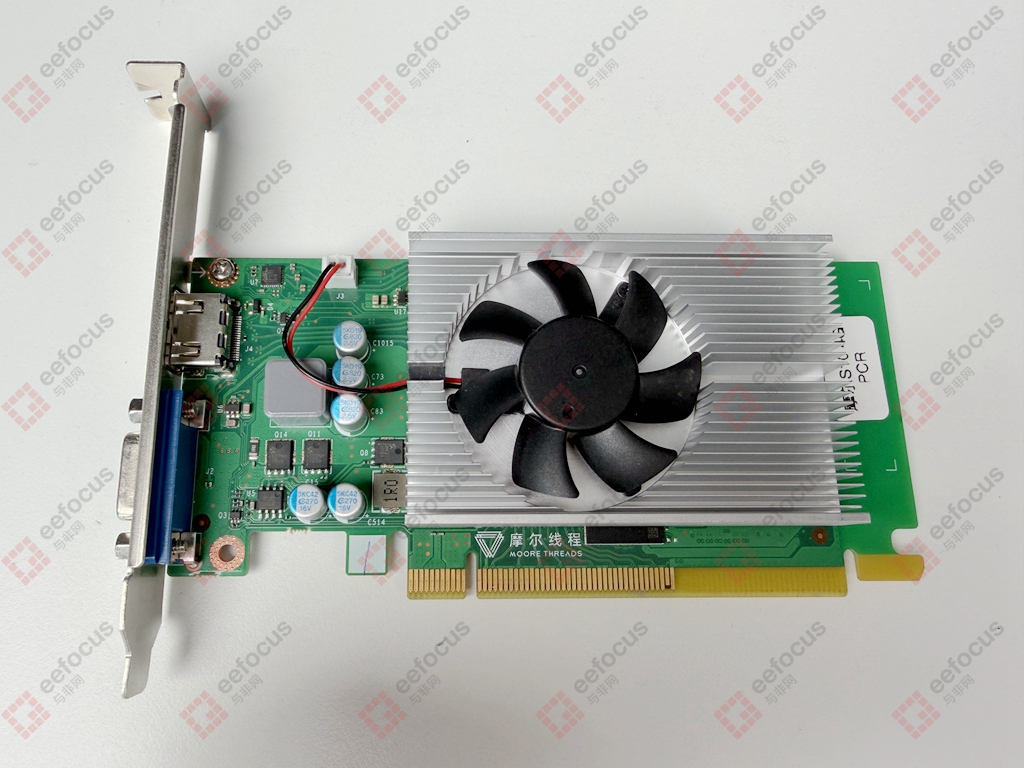
The S10 is mainly designed for office work, high-definition video playback, multi-person video conferencing, and similar scenarios, not for high-performance gaming. Its core value lies in its low-power design, requiring no external power supply; good compatibility, based on Moore Threads' self-developed MUSA unified system architecture; and it also supports 4K 60Hz display output, making it capable of handling various video conferences and HD video playback. A close look at its appearance reveals only VGA and HDMI output interfaces. Additionally, the front of the card features a cooling fan. Next, we proceed with the teardown to see what the hardware solution of a graphics card based on a domestic GPU looks like.
Teardown
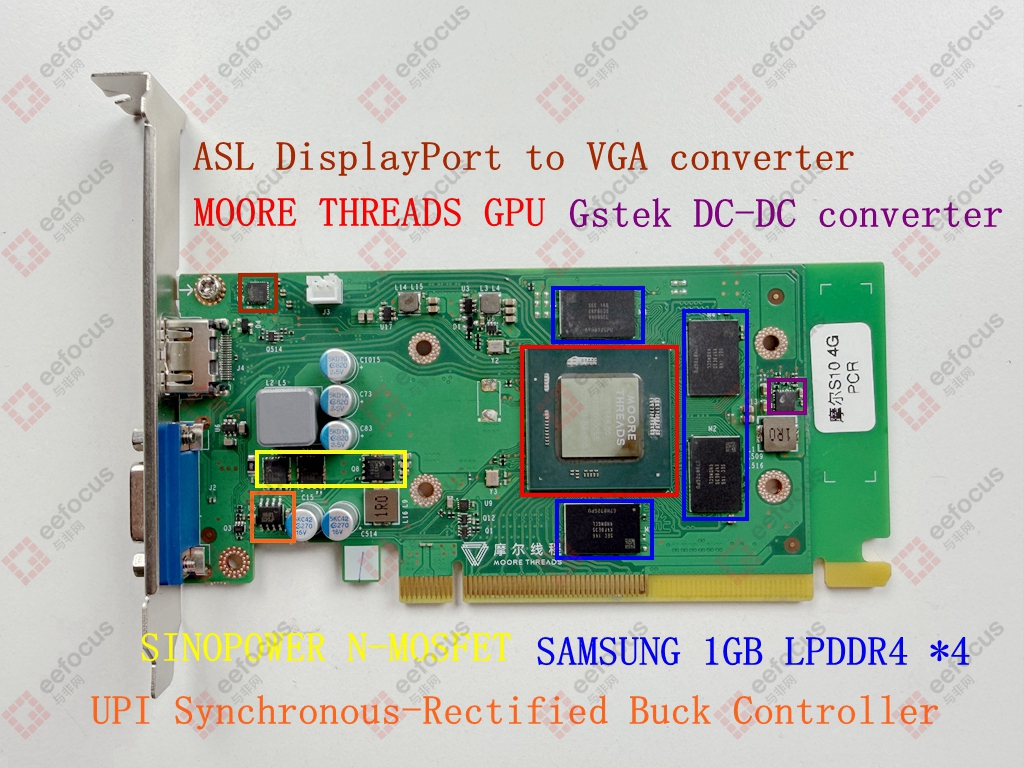
Removing the cooling fan module essentially completes the disassembly. Thermal paste was applied between the aluminum heatsink block and the GPU, which was cleaned off during the teardown, allowing us to directly see the English name and model number silkscreened on the GPU chip.
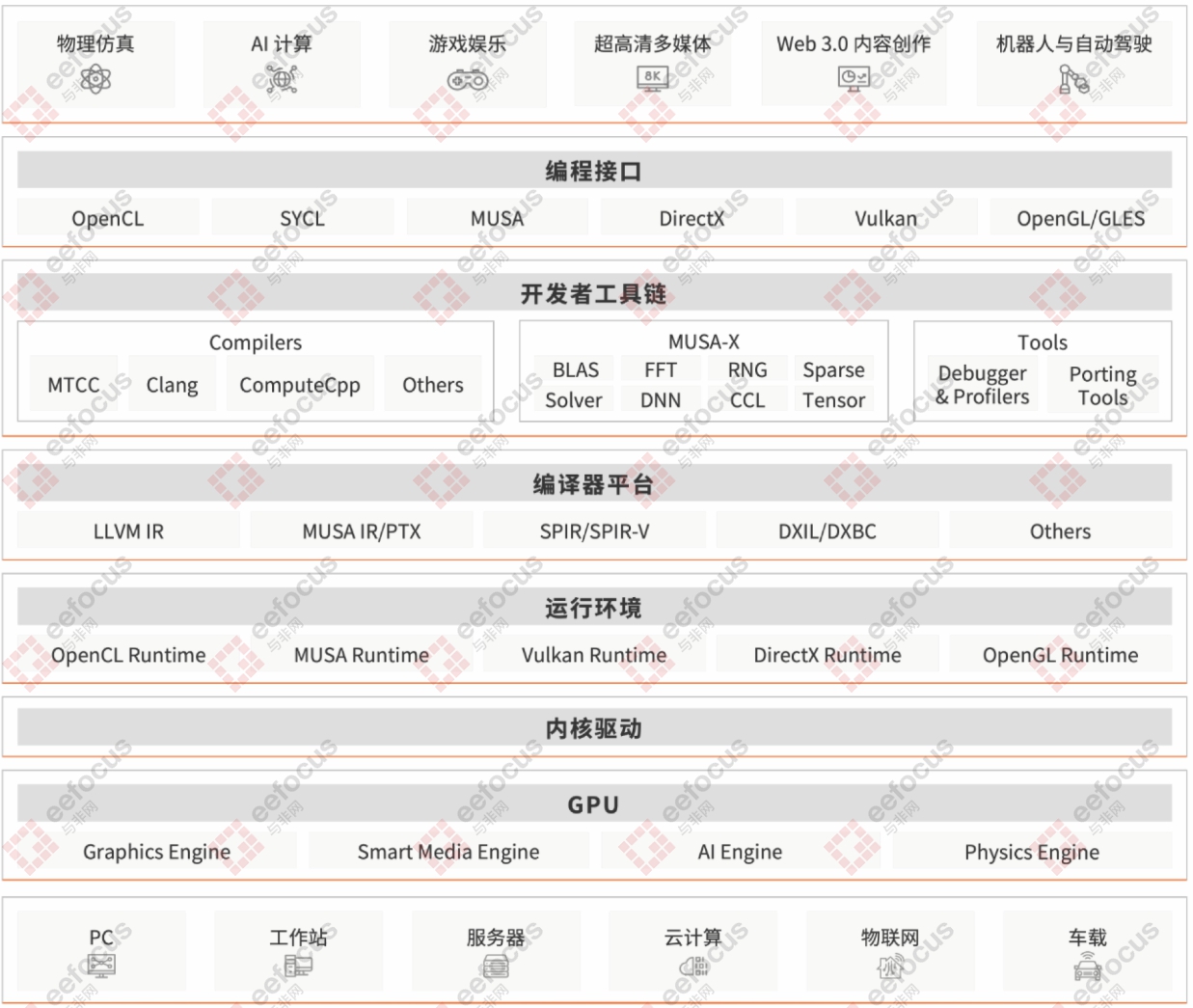
According to information from the official website, the GPU on the S10 graphics card is based on the first-generation MUSA unified system architecture. This architecture builds a full-stack technology system from underlying hardware to upper-layer software. Its core components include a unified chip architecture and instruction set architecture as the hardware foundation, accompanied by a unified driver framework, software runtime libraries, and programming models, together forming a complete development ecosystem.
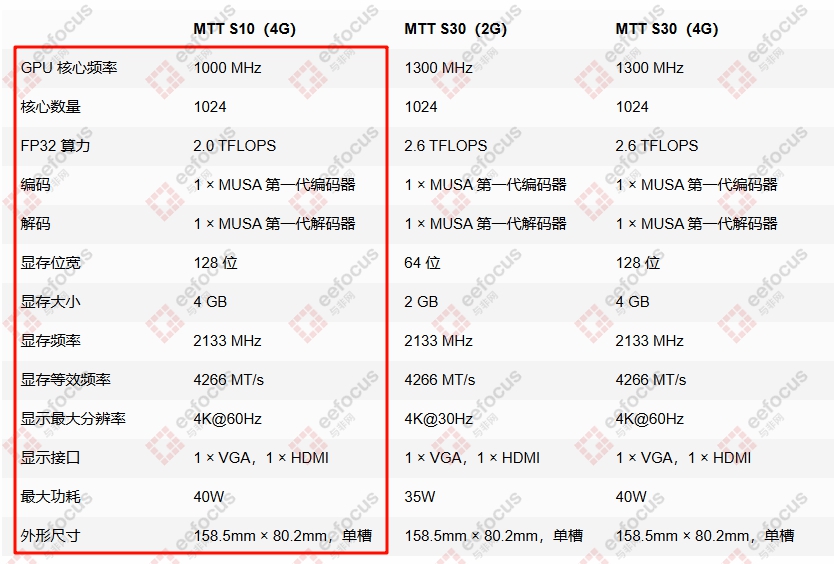
Specifically, this GPU can be seen to have a frequency of 1GHz and 1024 cores. The maximum power consumption of this graphics card is only 40W.
Next to the GPU are four Samsung 1GB LPDDR4 chips (K4F8E3S4HD-MGCL), serving as the video memory. Next to the large-encapsulation surface-mount inductor is the power management chip, a DC-DC converter GS9221 from Gstek, used for medium-to-high current power management.
On the other side of the PCB are the power supply section and the interface section of the graphics card. The power supply section chips include a synchronous rectification step-down controller, the UP1542S from UPI Semiconductor. This is a synchronous rectification step-down controller designed for 5V or 12V power supply systems, with the core goal of providing high-quality, stable output voltage. The chip employs a constant-frequency voltage-mode control scheme, combined with a built-in MOSFET driver, which not only simplifies external circuit design (fewer peripheral components) but also significantly improves power conversion efficiency. Its internally integrated various protection functions (such as over-voltage/under-voltage protection, over-current protection, short-circuit protection, etc.) and internal soft-start mechanism further enhance system stability and reliability, while achieving fast transient response.
Paired with the UP1542S are three N-MOSFETs from SINOPOWER, though of different models: two with model number SM4522NHKP and one with model number SM4377NSKP.
The interface circuit section uses a DP-to-VGA chip (CS5232) from ASL.
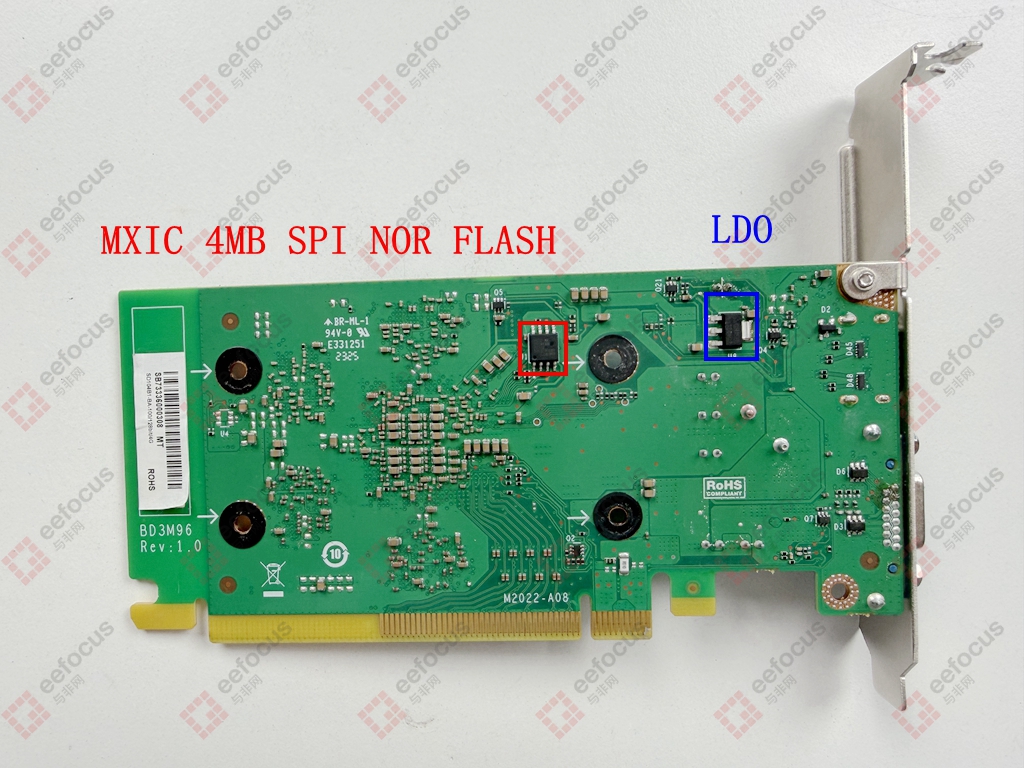
The back of the S10 graphics card mainly features two components: one is a 4MB SPI NOR FLASH from Macronix , model MX25U3232FM2I02, used for storing system firmware; the other is an LDO, providing stable power to the board.
Summary
The above outlines the hardware solution of Moore Threads' entry-level graphics card S10. The overall hardware design reflects the differentiated competition strategy of Chinese GPUs in specific market segments, replacing the single-minded pursuit of high-end graphics card performance with low power consumption and high compatibility. As noted by experts in China's semiconductor industry, Chinese GPU chips have moved from solving the problem of "having or not having" to the stage of being "good to use." Products like Moore Threads' S10 are precisely examples of innovation driven by application scenarios, gradually building a self-sufficient and controllable foundation of computing power. You may not need to use it, but it must exist!
来源: 与非网,作者: 曹顺程,原文链接: https://www.eefocus.com/article/1929243.html