芯耀
芯耀
 与非AI
与非AI





 2011
2011
April 28, "Global First AI Optical Computing Stock" Lightelligence Surged Over 380% on HKEX Debut!

Two Major Product Lines: Photonic Computing and Photonic Networking
As a world-leading provider of hybrid optical-electronic computing power, Lightelligence relies on three core technologies—Optical Matrix Computing (oMAC), Optical Network-on-Chip (oNOC), and Inter-chip Optical Networking (oNET)—to layout two major product lines: Photonic Computing and Photonic Networking. Leveraging the technical advantages of low latency, high throughput, and low power consumption, the company achieves a transformative upgrade in computing performance, providing support for the high-efficiency and low-carbon computing power demands in the fields of AI and Big Data.
- Photonic computing's main products include the PACE series hybrid optical-electronic computing acceleration cards, the photonic computing evaluation board Gazelle, the optical computing simulator LTSimulator, and the hybrid optical-electronic computing acceleration card OptiHummingbird based on oNOC.
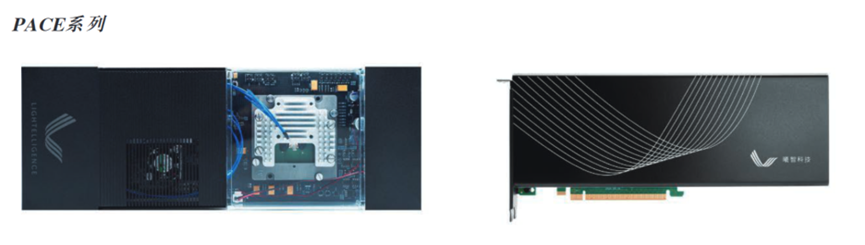
Image source: Lightelligence Prospectus
By replacing electrons with photons for data processing, the company's optical computing processors utilize photonic linear computing units to accelerate operations. These units are less restricted by process nodes and possess characteristics such as low latency and high throughput, thereby continuously breaking computing performance boundaries and reshaping chip performance standards.
According to Frost & Sullivan, the company's highly flexible and scalable optical computing solutions have spawned iconic products, including the world’s first hybrid optical-electronic computing acceleration card based on oNOC, OptiHummingbird, and the world’s first hybrid optical-electronic computing acceleration card with 3D Through-Silicon Via (TSV) packaging, PACE 2 (Xizhi Tianshu). The company has achieved the deployment of thousands of cards, pushing optical computing technology from the laboratory to industrial application.
Compared to traditional electronic computing, optical computing naturally possesses advantages in low latency and high throughput, thereby achieving a massive leap in single-chip performance. Taking 64×64 matrix operation as an example, the company’s oMAC technology can shorten the computing time of traditional electronic chips from the microsecond level to approximately three nanoseconds, improving performance by several orders of magnitude. Currently, the "Xizhi Tianshu" hybrid optical-electronic computing acceleration card has been successfully applied in fields such as EDA, quantitative trading, and banking, gaining wide recognition from customers.
- Optical interconnect's main products include the LightSphere series GPU supernodes.
Relying on industry-leading optical-electronic chip technology, the company provides comprehensive solutions for connecting various computing devices (including GPUs, CPUs, xPUs, switches, and storage chips) via optical signals. Optical interconnect solutions are used to enhance the computing capability within a single server or node (scale-up), or to connect multiple independent servers or nodes to form large clusters (scale-out).
Compared to electronic interconnect solutions, optical solutions offer lower latency, higher bandwidth, and higher energy efficiency. The company’s Scale-up and Scale-out series products provide comprehensive solutions from single-chip to data center levels. Scale-up hardware and solutions support the construction of high-performance supernodes, while Scale-out hardware and solutions can connect multiple supernodes into large-scale distributed computing clusters.
Among them, the company’s LightSphere 128-card commercial version has shown outstanding performance in AI large model training, with transmission latency reduced by more than 90% compared to traditional electronic switching.
It is worth mentioning that among China's independent Scale-up optical interconnect solution providers, Lightelligence ranked first in the domestic market by revenue in 2025, accounting for approximately 88.3% of the market share.
Optical Interconnect Scale-up Products Account for Over 70% of Revenue; Cumulative R&D Expenses Exceed 1.1 Billion Yuan Over the Past Three Years
The prospectus shows that Lightelligence's revenue from 2023 to 2025 was 38 million yuan, 60 million yuan, and 106 million yuan, respectively, with the growth rate significantly increasing in 2025.
Among them, optical interconnect sales constitute the main source of income, with Scale-up products becoming the core of growth. From 2024 to 2025, the revenue from optical interconnect Scale-up products increased from 47.02 million yuan to 75.58 million yuan; in 2025, the revenue from optical interconnect Scale-out products was relatively small, at 5.11 million yuan.
Optical computing products also showed a rapid growth trend in 2025, with revenue of 20.20 million yuan, a significant increase of 579%. It is worth noting that optical computing is still in the early stages of commercialization, and downstream applications are still continuously developing. Currently, the company's optical computing products are mainly supplied to early users such as enterprises, scientific research institutions, and universities for scientific research, technical verification, and pilot projects.
Meanwhile, the company's customer base continues to grow, increasing from 1 customer in 2022 to 22 customers by the end of 2024, and further increasing to 44 customers as of December 31, 2025.

Image source: Lightelligence Prospectus
In terms of research and development investment, Lightelligence's cumulative R&D expenses from 2023 to 2025 exceeded 1.1 billion yuan. Currently, the company is developing high-integration optical interconnect technology to solve the power consumption, cost, and reliability challenges of AI supernode construction, and has formulated a three-stage roadmap to evolve progressively from LPO to NPO and CPO, shortening signal transmission paths and improving efficiency. In addition, PACE 3 is currently in the front-end design and RTL coding stage, expected to tape out in the first half of 2026, with engineering samples planned for delivery to customers in the first half of 2027.
来源: 与非网,作者: 史德志,原文链接: https://www.eefocus.com/article/2001624.html