芯耀
芯耀
 与非AI
与非AI





 663
663
After market close on August 12, Tencent Holdings released its second-quarter results for the period ending June 30, 2026. Revenue reached RMB 204.78 billion, representing an 11% year-on-year increase, marking a return to double-digit growth after several quarters. Gross profit stood at RMB 118.43 billion, with gross margin holding steady at 58%. However, quarterly capital expenditure hit RMB 52.78 billion, surging 176% year-on-year, sending free cash flow down to negative RMB 13.8 billion.
On one side, gaming, advertising and WeChat Channels continue to deliver steady cash inflows. On the other side, capital is pouring into AI infrastructure at an unprecedented rate. From the author’s perspective, neither of these constitutes the core story. The key takeaway is that Tencent’s AI flagship is about to set sail.
Let us start with the big picture: the RMB 52.8 billion outlay is not a regular annual expense.
Martin Lau, President of Tencent, put it plainly: “Capital expenditure targeting AI-native businesses represents concentrated one-off investment primarily in this year and next. Investors should not assume we will maintain the same level of heavy spending every year. Model training involves fixed costs; we only need to reserve sufficient computing power. Inference computing power will only be added continuously if it generates meaningful returns. Otherwise, we will cap investment at the current scale.”
James Mitchell, Chief Strategy Officer and Senior Executive Vice President of Tencent, expressed a similar view. The business should be separated into two sets of books. Mature core businesses including gaming, advertising, social communications and payment feature strong operating leverage and self-sustaining cash flow. AI-native businesses, covering self-developed large models, WorkBuddy, Xiaowei, Yuanbao, alongside newly built computing infrastructure, represent upfront one-off startup costs in 2026 and 2027, rather than perpetual cash burn.
Management outlined two priority directions for capital allocation. The top priority is advancing the development of Hunyuan Hy4, a large-parameter model. The official version of Hunyuan Hy3 has secured a place among the top three globally by token consumption on OpenRouter, with average daily calls seven times that of its preview version. Hy4 is scheduled for launch within this year. The second priority is guaranteeing inference computing capacity for WorkBuddy, CodeBuddy, Xiaowei and Yuanbao.
WorkBuddy: Leading domestic B-end Agent race, pulling far ahead of rivals
If 2026 marks the “Year of Office AI Agents”, data from the Yiguan Insight Report China Office AI Agent Platform Market Analysis for Q2 paints a striking picture. WorkBuddy recorded 20.97 million PC visits in June, ranking first nationwide, exceeding the combined visits of the second and third-place players. Four Tencent offerings feature among the top ten platforms by monthly visits: WorkBuddy, CodeBuddy, QClaw and Marvis.
Tencent’s AI office agent products jointly captured a 53.8% share of the desktop AI agent market in China.
The chart shows Baidu Index trends for three major Agent platforms: WorkBuddy, QoderWork and Trae as of August 9, with WorkBuddy holding a clear lead.
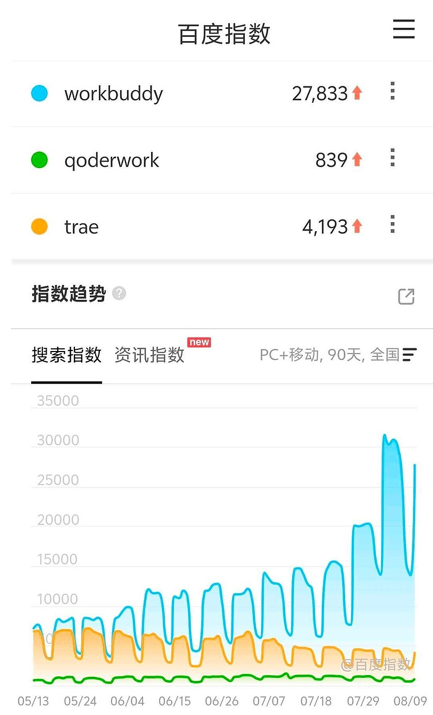
The core highlight extends beyond leading traffic metrics. Three key milestones stand out. Following integration with Hy3, task completion rates rose from 72% to 90%. Token revenue reached RMB 119 million in July, nearly doubling month-on-month, capturing a 35% market share. Gross margins from paying enterprise users have matched the overall gross margin level of Tencent Cloud. Enterprise editions have been deployed across more than 50 industry scenarios including Guangdong government services and Shenzhen Port, proving viable real-world commercial application.
Martin Lau outlined a clear, high-level positioning for the product: WorkBuddy is more than an add-on plugin for Tencent Docs or Tencent Meetings. It serves as a universal productivity workspace built for the AGI era. Constructed on an underlying scheduling framework, Hunyuan acts as one core foundation rather than the sole foundation. Its competitive targets include DingTalk, Feishu and Coze.
WeChat’s Xiaowei vs. Doubao: The battle between WeChat Channels and Douyin is set to replay for C-end AI portals
Xiaowei, WeChat’s native AI assistant launched for grey-scale testing in June, was cited by Martin Lau during the earnings call in comparison with the mobile transition from QQ to WeChat. “Xiaowei represents WeChat’s second major leap forward into the AI era.”
To understand Xiaowei, one must first grasp its differences from Doubao — a dynamic mirroring the rivalry between WeChat Channels and Douyin.

The WeChat Channels playbook unfolded as follows. While its recommendation algorithm lagged Douyin, it carved out sustainable traction via social recommendations and closed-loop functionality within WeChat, forming differentiated positioning against Douyin’s high-immersion public feed model.
Notably, average usage duration on WeChat Channels rose 20% year-on-year in Q2 2026.
Xiaowei is following an analogous growth path. Rather than blindly chasing the peak performance benchmarks set by Doubao in model parameters, WeLM adheres to a development philosophy of sufficient capability, privacy protection and deep integration within WeChat-native scenarios. Yet it commands exclusive moats inaccessible to standalone Doubao apps: WeChat’s 1.432 billion monthly active users, 973 million mini-program monthly active users, plus the entire WeChat Pay ecosystem.
Developers only need to enable authorization via the AI capability panel in the Mini Program Admin Console, allowing Xiaowei to trigger corresponding services via natural language commands. This mechanism mirrors how WeChat Channels revitalized official accounts and mini-programs in previous years.
Martin Lau stated plainly during the briefing that Xiaowei will not divert advertising revenue or transaction GMV. Instead, it enables a complete value chain: user prompts trigger intelligent merchant agents, which facilitate closed-loop transactions via mini-programs. This evolution transforms WeChat from a mobile operating system into an AI operating system.
Between large models and end applications: Tencent Cloud becomes the revenue backbone supporting the RMB 52.8 billion capital expenditure
Financial results reveal daily token calls on TokenHub, Tencent’s large model service platform, have exceeded 25 trillion, growing fivefold within two months. This explosive growth is driven both by internal demand from products such as WorkBuddy and robust external client demand for GPU leasing and MaaS offerings.
Management confirmed that by late 2026 through 2027, once GPU and ASIC capacity reserves are in place, Tencent Cloud will scale bare-metal server leasing and MaaS exports. These streams will not only supply cash flow for AI operations but also deliver strong resilience amid industry demand volatility.
Closing Remarks
Pony Ma structured Tencent’s AI layout into a three-tier architecture. At the intelligence layer, Hunyuan Hy3 forms the foundational capability base, while Hy4 targets cutting-edge technological advancement. At the application layer, WorkBuddy and CodeBuddy strive to secure a leading domestic position; Xiaowei reshapes WeChat’s traffic entry point, and Yuanbao maintains presence as an independent C-end consumer app. At the infrastructure layer, the planned RMB 52.8 billion capital expenditure enables efficient conversion of model and application traffic into revenue.
Accordingly, the Q2 performance cannot be framed as a story of profits under pressure due to AI spending. Fundamentally, Tencent is utilizing two years of phased capital expenditure in 2026–2027 to secure three core tickets for the AI era: large models, end applications and computing infrastructure. WorkBuddy has already proven its scale of user engagement and token monetization capacity. Xiaowei, in grey-scale testing, is highly likely to replicate WeChat Channels’ growth trajectory, while Tencent Cloud’s MaaS business reinforces the fundamental earnings base.